 Academic Happiness Map - Submission
Academic Happiness Map - Submission
Academic Happiness Map - Submission
The Academic Happiness Map is an open, community-driven project designed to explore how people in academia experience their professional lives. Researchers, students, postdoctoral fellows, faculty members, and academic staff from around the world can anonymously report their current level of happiness in academia using a simple numeric scale.
These responses are transformed into interactive visualizations that reveal patterns across geography, career stage, and research discipline. A global map displays responses spatially, allowing visitors to explore regional trends and clusters of academic sentiment.
Interactive filters allow comparisons across career stages and research fields, while additional charts summarize patterns in happiness distribution, disciplinary differences, and global participation.
The visualization below illustrates how responses submitted to the Academic Happiness Map are transformed into insights about academic well-being across the global research community.
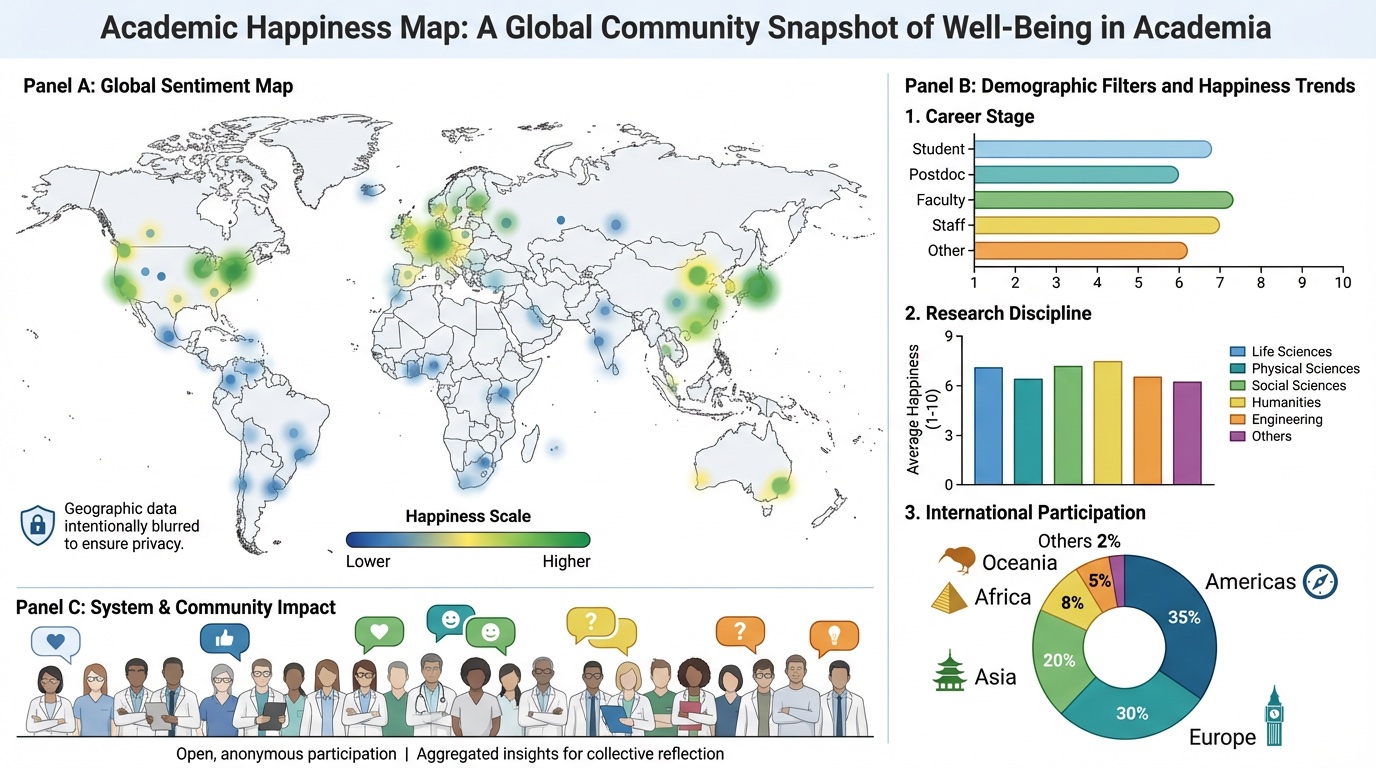
Panel A: Global Sentiment Map
Individual responses appear on a world map to illustrate geographic patterns in academic well-being. To protect privacy, geographic coordinates are intentionally blurred so that individual participants cannot be identified while still preserving regional patterns.
Panel B: Demographic Filters and Happiness Trends
Responses can be explored across career stages and research disciplines. These visualizations allow comparisons among students, postdoctoral researchers, faculty members, and staff, as well as across academic fields.
Panel C: System and Community Impact
Aggregated responses provide a collective reflection of academic life. The purpose is not to evaluate individuals or rank institutions, but to reveal patterns that may help stimulate conversations about academic culture and well-being.
The Academic Happiness Map uses a simple 0–10 scale to capture how individuals currently feel about their experience in academia. The scale reflects a broad range of academic experiences, from severe dissatisfaction to highly rewarding environments.
| Score | Mood | Meaning in Academic Life |
|---|---|---|
| 0 | Completely unhappy | Academia feels unbearable. Strong regret about being in the system. |
| 1 | Extremely unhappy | Constant stress or dissatisfaction. Feeling trapped or unsupported. |
| 2 | Very unhappy | Academic environment feels harmful or discouraging. |
| 3 | Unhappy | Significant dissatisfaction with work conditions or career outlook. |
| Struggling in academia (0–3) | ||
| 4 | Slightly unhappy | More negative than positive experiences. |
| 5 | Neutral | Neither happy nor unhappy. |
| 6 | Slightly happy | Generally positive but with frustrations. |
| Mixed experience (4–6) | ||
| 7 | Happy | Mostly satisfied with research or career progress. |
| 8 | Very happy | Strong positive experience in academia. |
| 9 | Extremely happy | Academia feels rewarding and meaningful. |
| 10 | Exceptionally happy | Ideal academic environment and career satisfaction. |
| Happy in academia (7–10) | ||
Protecting participant privacy is central to this project. The platform collects no personally identifiable information. Individual responses are not displayed at exact locations. Instead, submissions are aggregated at the city level and visualized using approximate city coordinates to preserve regional trends while protecting participant anonymity. No names, institutional affiliations, or precise addresses are collected or displayed.
Academic careers often involve intense intellectual demands, long training periods, uncertain career trajectories, and significant pressure to publish, secure funding, and maintain productivity. Despite these challenges, discussions about well-being in academic environments are often limited or informal.
The Academic Happiness Map aims to provide a transparent and community-driven perspective on these experiences. By aggregating anonymous responses from across the global research community, the platform creates a shared snapshot of how people experience academic life at different stages of their careers.
The map allows the academic community to see patterns in well-being across regions, disciplines, and career stages.
Visualizing global academic sentiment can help highlight common challenges related to work environments, career pressures, and mentorship.
The project encourages open discussions about academic culture, career development, and well-being in research environments.
By contributing responses, researchers help build a shared understanding of the human side of academic life worldwide.
The Academic Happiness Map was initiated and developed by Dr. Alper Uzun, Associate Professor at Brown University. The project was created as an open initiative to explore patterns of well-being in academia through anonymous community participation and transparent data visualization.
By collecting and aggregating responses from researchers around the world, the platform aims to provide a global snapshot of how academic professionals experience their careers at different stages. The project seeks to encourage thoughtful conversations about academic culture, mentorship, career development, and well-being in research environments.
The Academic Happiness Map is intended as a community resource and an evolving platform shaped by participation from the global academic community.
Through open participation and transparent visualization, the Academic Happiness Map invites the global academic community to contribute to a shared understanding of well-being in academia.
The Academic Happiness Map is a community-driven initiative exploring the global mood of academic life across different career stages and disciplines.
Questions, suggestions, or ideas to improve the project are always welcome. If you are a researcher, educator, or member of the scientific community interested in the project, we would be happy to hear from you.
You can reach the project at: academicmap [at] biocomicals [dot] com